Decoding the Valence of Developmental Social Behavior: Dopamine Governs Social Motivation Deficits in Autism
Nov 12, 2025· ,,,,,,,,,·
1 min read
,,,,,,,,,·
1 min read
Xinfeng Chen
Xianming Tao
Zhenchao Zhong
Yuanqing Zhang
Yixuan Li
Ye Ouyang
Zhaoyi Ding
Min An
Miao Wang
Ying Li
Abstract
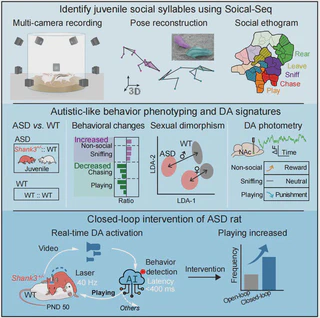
The social motivation theory posits that core social deficits in autism spectrum disorder (ASD) arise from impaired social valence assignment during the social critical period, yet the specific dopaminergic mechanisms governing this process remain unclear. We combined high-resolution behavioral sequencing (Social-seq) with fiber photometry to resolve nucleus accumbens (NAc) dopamine during naturalistic juvenile interactions. Sex-divergent social strategies emerged – males exhibited peer play-dominant interactions with action-contingent dopamine release, while females favored environmental exploration with attenuated social dopamine. Shank3-deficient juveniles exhibited a triad of dopaminergic dysregulation—blunted signaling during social investigation, pathological inversion during active play, and hyper-responsive to non-social stimuli—recapitulating ASD-like phenotypes. Closed-loop activation of dopamine during play rescued social deficits, establishing a causal link between phasic dopaminergic signaling and social motivation. These findings identify NAc dopamine as a dynamic encoder of social valence and suggest that temporally precise modulation of dopaminergic circuits may offer therapeutic leverage for ASD-related social impairments.
Type
Publication
bioRxiv
See the full text here: https://www.biorxiv.org/content/10.1101/2025.11.12.687985v2
