
Decoding the Valence of Developmental Social Behavior: Dopamine Governs Social Motivation Deficits in Autism
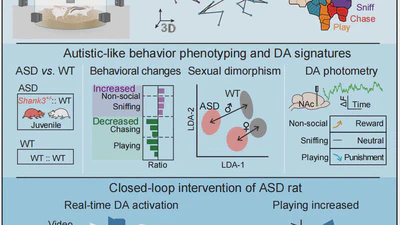
Using deep learning to automatically decode the social behavior and its valence from behavioral sequences.

Xinfeng Chen (陈昕枫) is a AI Engineer at Xinqiao Hosiptal Army Medical University. He is a leading researcher in the field of AI, where he leads groundbreaking work on large language models and multimodal systems. His research has been published in top conferences like NeurIPS and ICML, with over 10,000 citations. Chen is passionate about pushing the boundaries of AI while ensuring ethical development. Outside of work, he enjoys hiking in the Rockies, building custom PCs, and mentoring the next generation of AI talent.
PhD, Peking University (北京大学)
Life Science (AI Focus)
MS, Huazhong University of Science and Technology
Biomedical Engineering
BS, Huazhong University of Science and Technology
Life Science
Key Problem: Psychiatry faces a critical barrier: psychiatric diagnosis relies on subjective human experience, lacking quantitative analysis—undermining reliability.
My Approach: To solve this, my PhD developed an AI/big data behavioral diagnostic tool (validated in rats), integrating multimodal data (behavior, vocalizations, neurotransmitter signals) and high-performance computing to outperform human analysis.
My Discoveries: The tool identified comprehensive abnormalities and diagnostic biomarkers in psychiatric model rats, and informed effective optogenetic interventions for symptom relief.
Future Plans: Noting gaps (AI’s poor generalization/interpretability; animal-human differences), I will transition to clinical research. I’ll apply my skills in device development, algorithm integration, and big data analysis to advance precise psychiatric diagnosis/treatment.
Please reach out to collaborate 😃
Using deep learning to automatically decode the social behavior and its valence from behavioral sequences.
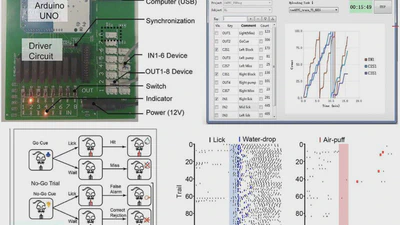
Arduino UNO based Behavioral Platform for animal training like Go/No-Go task.